Friday, October 23, 2009

Are you using Twitter yet? Why not?


I'll be the first to admit that I was a little skeptical about using Twitter. What's it going to do for me? Who cares about what I have to say? Why do I care about what people are doing? At first glance, it does seem like Twitter is just one more way for people to "lifecast" (broadcast their life). However, throughout the last few months I've learned that Twitter is so much more than just a way to talk about yourself--it's a way to build your own PLN (Personal Learning Network).

What is it?

Twitter is a free online service that lets you broadcast (very) short messages to your "followers". Sometimes, it's promoted as a microblogging platform (regular blog = long, descriptive; microblog = short and sweet). It also lets you "follow" people so that you can see their updates.

Anything else I should know?

  • Twitter updates are limited to 140 characters, so you don't have room to say a lot. That's actually one of the greatest features of Twitter. It's easy to glance through your "updates" to get a snapshot of what's going on. You can usually click on links within the updates to learn more about the topics. It's kind of like perusing the newspaper--you can look at the headlines and 0nly read the stories you're interested in.
  • Once you have an account, you'll have your own Twitter username (e.g. @cclancy) and your own Twitter page (e.g. www.twitter.com/cclancy).
  • You can have Twitter updates sent to your cell phone. Login to Twitter and click "settings" to set it up.
  • I think that Twitter is all about who you follow: the better your network, the better your updates, the better it will work for you. Your best bet is to find someone worth following, and then look at his or her list of followers.

How can Twitter help me in school?

Twitter has been an amazing tool to help build my PLN. Your current learning network might be limited to your grade level or department. Need a new idea? Ask the Twitterverse for help! Or, search for keywords, like "socialstudies" or "geometry" at Twitter.com.

You can also use Twitter to follow world events...as they are happening. Search for keywords like "H1N1", "balloonboy", or "northwest" and you'll see realtime updates from people around the world as they tweet about Swine Flu, Balloon Boy, or the status of the crew from the Northwest flight that extended their trip...

How can I get started?

  1. Go to http://www.twitter.com/
  2. Register for a free Twitter account.
  3. Find people to follow using Twitter's search button.
  4. Start tweeting!

Twitterers you might want to follow

(Click on their name to go to their page. click "follow" underneath their name to follow them):

Still want more? Check out my Twitter Del.icio.us links or this Twitter Help for Educators!

Good Luck!

Chris

Thursday, October 8, 2009

MuseumBox: Virtual Learning Boxes

What items would you put in a box to describe your life? What about the life of a Civil War soldier? An ancient Egyptian?

What is it?
Based on a real box that was created by Thomas Clarkson, a British abolitionist from the 19th century, MuseumBox is a website that lets you build an argument or describe an event by placing items into a virtual box.

Each box can have between one and 24 compartments for users to place "objects". Each compartment has a virtual "cube" that holds the objects. A wide range of objects can be added to the cube faces, including images, video, sound, text, web links, and PowerPoint, Word, and PDF files!

High School social studies teacher Mrs. Mary Tully contacted me recently about doing a MuseumBox project with her 9th grade Global Studies classes. She was looking for a different way for them to demonstrate their understanding of the 5 Themes of Geography. Working in groups of 2 or 3, they used Google's Advance Search features to research, Image Search for pictures, and cited everything with Citation Machine!

Click here to see one group's MuseumBox! Make sure you click on each of the cubes!


How does it work?
  • Teachers need to register their school with the MuseumBox website. When students create their accounts, they will select their school and be identified by it on the site.
  • Students open the Creator, build their box and cubes, and save it at the MuseumBox website. Objects can come from the MuseumBox gallery, or they can be uploaded.
  • When students are finished with their boxes, they "submit" them virtually through the website. At that point, teachers can log in, view, and evaluate their class' boxes. If the box is approved by the teachers, it becomes part of the school's gallery of MuseumBoxes. UPDATE (1/5/10): Once boxes are submitted, teachers need to review and approve or reject them within 2 weeks. After that time, any boxes that have not been reviewed will be forwarded to the e2bn (MuseumBox) administrators. You'll have to email the company to get them back.

Anything else I should know?

  • MuseumBox is a UK site, so many of the images in their gallery were UK-based.
  • If students are collaborating on one box, it's important that only one student is modifying it at a time. If more than one person opens the box, it's possible that work could get accidentally deleted.
  • The entire project (with Mrs. Tully's students) took about 2 block periods, or about three 45 minute sessions.
  • MuseumBox is not just for social studies teachers! It has lots of applications for other classes as well!

I found MuseumBox to be VERY user-friendly, reliable, and engaging for the students. I was impressed with how much they were able to do in such a short amount of time.

Please let me know if you're interested in doing a MuseumBox project with your class!

Good Luck!

Chris

Thursday, June 4, 2009

Looking for Easy-to-Print Awards? Try My Award Maker

It's the end of the school year and award season is upon us. This is the time when teachers and schools look for ways to recognize their students' accomplishments with field trips, ceremonies, graduations...and awards.


What is it?

My Award Maker is a free and very easy website that allows you to download and print personalized awards for your students and colleagues. This site takes the hassle out of using programs like Microsoft Publisher because the template is completely finished--all you have to do is enter the name of the recipient!


How do I make an award?

  1. Go to http://www.myawardmaker.com/
  2. Choose an award category and find an award you'd like to use
  3. Download the Award
  4. Open the award (it's a PDF file) and change the personal information (name, date, etc.)
  5. Print!

Anything else I should know?

  • While you can modify the personal information (names, dates, etc.) on the downloaded awards, you can't modify anything else (clipart, font, colors, etc.). Basically, WYSIWYG.
  • There is a section called "blank templates" that allows you to have a little more freedom with the award (they're not set up as specific awards--you customize them).

Good Luck!

Chris

Wednesday, June 3, 2009

Siftables: Hands-On Technology of the Future

Every once in a while, as I explore the Internet for the next great tech tool, I come across something amazing, something that blows my mind, something that is leaps and bounds ahead of everything else. A few days ago, I followed a link from one of the people that I follow on Twitter and discovered Siftables.


What is it?
Siftables are independent, wireless digital blocks that can communicate with each other. David Merrill, an MIT doctoral student and one of the developers of Siftables, was challenged with coming up with a way to make technology more "physical". He believes that people are skilled at using their hands to sift and sort through items to develop higher level thinking skills, but most technology devices don't lend themselves to that type of interaction. Siftables can be manipulated to play videos, spell words, solve math problems, create music, tell stories, and more. Watch this video of David presenting Siftables to a group in California.

The applications for education are obvious. Once Siftables are realeased and are available for purchase (hopefully they'll be affordable for schools!), they will change the way that we teach and the way that our students learn...again. I think that the thing that makes Siftables so unique and desirable is that they add a new layer to technology integration: making it hands-on. There are so many incredible websites and tools out there, but few of them allow users to physically interact (Those that do are incredibally popular--the Nintendo Wii--or expensive). I can't wait to try out Siftables with a group of students!

I know that there isn't really anything that you can take from this post and use with your students right now, but I thought that you might enjoy seeing (what I think is) something awesome.

Start planning now...how would you use Siftables with your students?

Chris

Tuesday, May 5, 2009

"I'll take EASY Jeopardy templates for $500, Alex!"

Have you ever used PowerPoint to make a Jeopardy review game for your students? If you have, you know that it can be a pretty involved process...lots of slides...lots of hyperlinking...lots of time...Unless your pretty adept at PowerPoint, it can get frustrating.

Well, I came across a solution that might just make your day.


What is it?

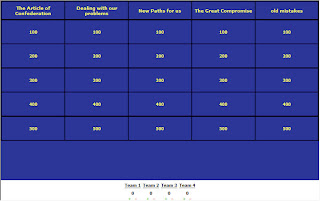
Jeopardy Labs is a website that lets you create your own Jeopardy templates online...QUICKLY!


How do I do it?
  1. Go to the Jeopardy Labs website.
  2. Click on "Start Building".
  3. Create a password to protect your Jeopardy template (so that others can't edit it)
  4. Enter a title for your game, as well as answer categories.
  5. Click on the question boxes to enter answers.
  6. Save your template, get the web address, and you're ready to play!

Here's a screenshot of a finished Jeopardy template:


Anything else I should know?

  • Jeopardy Labs is completely web-based, so everything you make will be stored on their website.
  • When you're finished with your game, you will receive 2 URLs (web addresses). One is used to play the game. The other is used to edit your template (so you can build your game in multiple sessions).
  • You can search other peoples' finished templates. Just click "Browse" on the website and enter a topic you're looking for. Try this before you make your game--it might save you even more time!
  • The template lets you select up to 8 teams and keep score (add or subtract points) for each of them while you're playing the game.
  • It is possible to insert pictures into the question boxes, BUT you need to have some HTML knowledge. I would just stick to text...
  • There is no "Double Jeopardy" or "Final Jeopardy" built in to the game, so you'll have to do that on your own outside of the template.
  • Take a minute to read the "About" page on the site. It will thoroughly answer questions that you still might have.

How can I use it in my classroom?

Jeopardy Labs does not require users to create an account and login! Why is that good news? Well, instead of creating a bunch of Jeopardy games yourself, why don't you have your students do it? We're approaching the end of the school year, and I'm sure many of you are gearing to review for final exams. Wouldn't it be beneficial to your students if they were the ones to lead some of the review sessions? You could assign topics to different groups and have them use Jeopardy Labs to create a game to review! It would save you time and help them review the curriculum.

Please let me know if I can help your class with Jeopardy Labs!

Good Luck!

Chris

Wednesday, April 29, 2009

Sick of PowerPoint? Try Prezi!


What is it?

Prezi is a very cool and fairly new free online presentation tool that (for me) has been a very refreshing (and much needed) alternative to PowerPoint. According to the website, Prezi allows anyone who can sketch an idea on a napkin to create and perform stunning non-linear presentations with relations, zooming into details, and adjusting to the time left without the need to skip slides. And, it looks great when it's finished!

PowerPoint presentations are typically "linear", meaning that viewing one means that you'll look at one slide, move to the next, and so on. I'm sure we've all seen great PowerPoint presentations...and we've seen examples that aren't so great. It's painful to sit through a presentation in which the speaker puts an unreasonable amount of text on the screen. Or, worse yet--when the presenter reads the text for you from the presentation! Where's the excitement with that? How is that engaging? As far as I'm concerned, it's virtually impossible to make a boring Prezi presentation.

How does Prezi work?
Instead of creating individual slides with information, Prezi gives you a "space" that allows you to insert text, pictures, and movies--literally jumping and zooming from one to the next. It really lends itself well to presentations that are created to encourage discussion or to highlight a few important points. Check out this Prezi tutorial that lets you try it to see how it works.


How can I use it in my classroom?
Obviously, if you're looking for a different way to present and engage your students, Prezi is perfect (A Prezi looks great on a SMART Board). I would suggest that you select a topic and give yourself a few days or weeks to create your Prezi presentation--just so you can get used to things. Prezi doesn't offer "teacher/student" account access, so if you'd like your students to use Prezi, they'd have to create their own individual accounts.

Anything else I should know?
  • Prezi is completely web-based, so you'll have to connect to the Internet to create and view presentations. Although, it is possible to download your own presentations when they're finished (you can't download other users' presentations, but you can view them)
  • The free Prezi account inlcludes 100mb of storage space (more than enough) and publishes finished Prezi presentations to their "Showcase". You should check out the Showcase to get ideas.
  • I would highly suggest that you check out the "Learn" page at Prezi.com before you begin working. It will make things easier. It took me a while to get used to the editing and viewing controls that Prezi uses, but it was well worth it.
  • Prezi is a European company, so you may notice a few language differences on some of its pages.
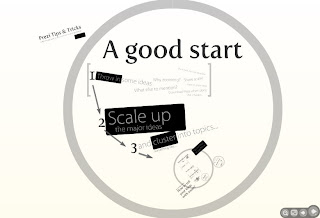
  • Here's another Prezi with some tips and tricks

Please let me know if you'd like my help using Prezi!

Good Luck!

Chris

Wednesday, April 22, 2009

Create Talking Avatars with Voki

What are Avatars?

Avatars are computer users' visual repsresentations of themselves. Many Web 2.0 sites ask registrants to upload photos of themselves when they create their profiles...although it's really not a great idea to post pictures of yourself publically anywhere on the web. Avatars are great alternatives--it's a picture of you, but it's not really you! (If you have ever played a Nintendo Wii, you've made an avatar. It's the character you use to play the game).


Voki is a website that allows users to create 3-dimensional avatars...that talk! It has some great features that allow users to design their own character (or browse through their premade avatars that include politicians, celebrities, creatures, aliens, characters, dogs, and cats!). Once you've created your character, you can give it a voice in one of 4 ways: using your cell phone, recording directly to the website with microphone, typing text that Voki will turn into speech, or uploading an audio file from your computer.

Social Studies teacher Mike Varney contacted me recently about a project idea he had that incorporated Voki. During his unit about the Vietnam War, Mike asked each of his students to write a speech as a “Dove” or “Hawk” stating whether they support The War. The students were asked to write from a first-person point of view and to provide reasons to support their opinions. However, instead of having the students recite the speeches in front of their peers, he helped them create avatars (digital representations of their War character) to “give the speeches for them”. Using Voki, Mike helped his students create their characters and record their speeches. The results were outstanding…and very entertaining. Check this one out:


What Else Should I know?
  • Voki is a free website, but it does require that users create accounts and register an e-mail address. Because Mr. Varney's students don't have school e-mail accounts, we used MailCatch to create enough accounts for each of the students to use.
  • There is a 60 second time limit for recording, so keep the narration short and sweet!
  • When they are finished, Voki avatars are embeddable. Mike's students embedded their avatars on his classroom website.
  • The entire project took 2 class periods: one to create the avatars, and one to record the speeches. It was definitely a quick project.

Please let me know if you'd like to try Voki with your students!

Good Luck!

Chris